MISOGI-SHINTO-PURIFICATION
POSITION
Group Project
DESCRIPTION
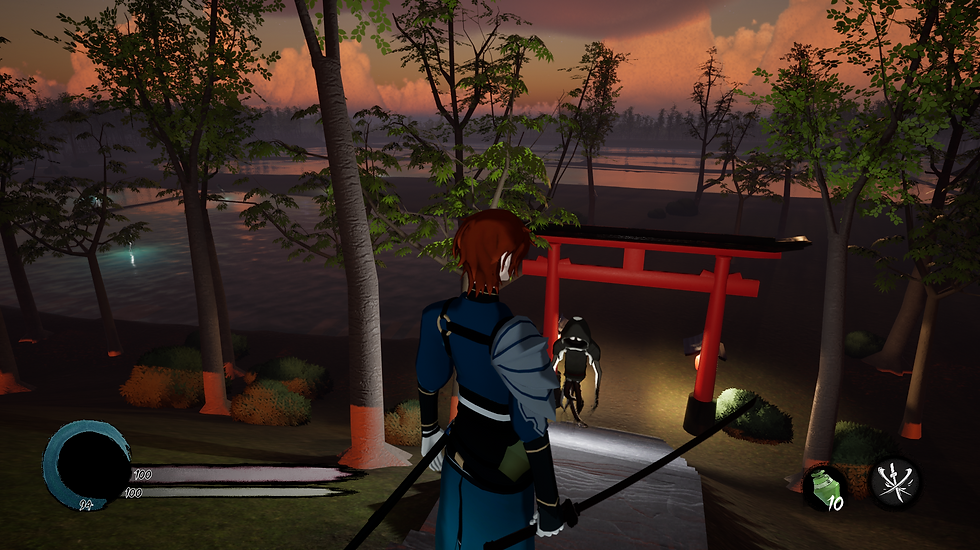
Misogi: Shinto Purification is a story-driven role-playing adventure. Therefore, the core gameplay loop revolves around the player engaging with so-called quest NPCs, who assign various tasks. These tasks either advance the main storyline or expand the game's world-building without affecting the overall narrative. The latter are referred to as side quests.
UPDATED
Soon on Steam (Okt 30. 2026)
GENRE
3D Story RPG
LINK
AS GAMEDESIGNER
In Misogi: Shinto Purification, I implemented a clever design. The goal was to incorporate regular action RPG elements into a more story-centered game. Therefore, I skipped the usual way of gathering experience points to level up in favor of a more dialogue-centered core gameplay loop. When players encounter a quest or a unique NPC, they can occasionally choose unique dialogue options that improve their favor with one of six gods: three benevolent and three malevolent. Choosing one god's option also means neglecting the other possible gods, and one god will oppose your choice. Once you have reached a certain level of favor with one or more gods, you can visit a shrine and obtain their blessing. This blessing manifests in your inventory.
Your inventory consists of an 8×16 grid of fields, or slots, in which items take shape. Items can stack if they are of the same kind, but they cannot overlap. Each item has a different shape reminiscent of the blocks in the famous game Tetris.
Once you obtain a blessing, some of the fields inside your inventory change to represent the god. If you overlap items with these fields, the god will buff them to suit your playstyle.
For example, if you have a lot of favor with Amaterasu, the goddess of the sun, a sun-like red circle of fields will appear at the center of your inventory. Amaterasu increases your maximum health and strengthens other items if you maintain high health.
In return, the god Mikaboshi will dislike you for having such high favor with Amaterasu. However, Mikaboshi is one of the three malevolent gods. The malevolent gods do not carry their blessings over to other maps. Instead, their influence remains in the map where they send enemies after you and force their way into your inventory. You can play into these gods' favor as well, but since their influence does not carry over to other maps, they tend to be unreliable.
In addition, they invert the effects of the three benevolent gods. Mikaboshi, for example, reduces your health while increasing your power far more than Amaterasu would. However, you would have to play at low health, which poses a great risk to the player.
If enemies become too strong, you have to seek the favor of the gods through the stories of other characters and adapt your roleplaying style to strengthen your playstyle. Alternatively, you can roleplay as yourself and see which god would bless you for it.
Either way, roleplay becomes strength, and that is what I aimed to achieve and accomplished in Misogi: Shinto Purification.
In our game project, Misogi: Shinto Purification, I was responsible for four main areas: programming, game implementation, story, and sound design.
As a programmer responsible for game implementation, I worked on the technical side of the game. My role was to add gameplay mechanics and systems such as the inventory, dialogue, quests, and enemy AI. I ensured that the different game mechanics worked together and that players could interact with the game world as intended. I also implemented the animations and 3D models of the designed characters and coded environmental effects such as weather and the day-night cycle.
As a sound designer, I focused on the audio experience. This included creating or integrating sound effects and environmental sounds that supported the atmosphere of the game.
The PDF on the right is the game design document.