Hobby
Dungeon Master
In Dungeons & Dragons (D&D), the Dungeon Master (DM) serves as both the game’s organizer and narrator. The DM creates the setting, develops adventures and challenges, manages the game world, and ensures continuity and consistency throughout the story. While the DM controls nearly every aspect of the game, the actions and decisions of the player characters (PCs) remain in the hands of the players. The DM describes the characters’ surroundings, events, and experiences, responding to their choices as the adventure unfolds. A typical D&D group consists of one Dungeon Master and several players.
1
Storyteller
I studied storytelling through years of reading fiction and nonfiction, watching films and television, and following YouTube creators who analyze narrative structure, character development, worldbuilding, themes, pacing, and dramatic tension.
But most importantly, I have the experience and understanding what the difference is, between telling a story to an audience and designing a story that an audience actively participates in.
Playlist I watched altogether
2
Group Manager
I regularly organized and facilitated D&D sessions for groups of 6+ players. Coordinating schedules and availability across multiple participants to an average of 2 sessions per Month. I Maintained continuity across ongoing campaigns by tracking player characters, progression, NPCs and previous decisions. But I also managed the flow of sessions in real time, adapting plans when encounters took longer than expected or players pursued unplanned objectives.
Recorded Gameplay
3
Game Designer
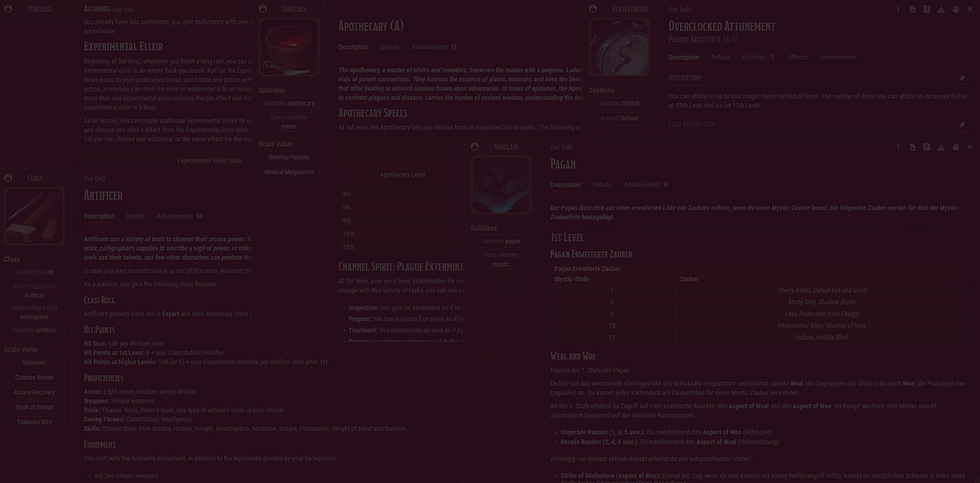
I designed and developed original player classes, subclasses, abilities, mechanics, and progression systems for Dungeons & Dragons. The goal was to fill in missing classes and balance all classes against each other. Of course, the DM can ban or enable certain features and spells, and players can agree not to build asymmetrically strong characters. Still, I wanted players to feel the procedural rethoric and that there are no invalid choices.
The system rewards and glorifies.
Webside
New Class
Meet the Mystic
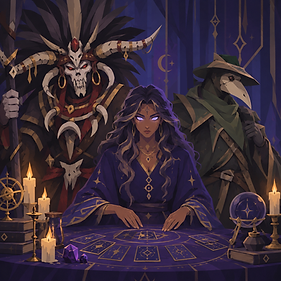
Where other see the spirit world as an enigma, for the mystic its like basic science, harnessing the power of the material and immaterial to enhance both themselves and their allies. Through their deep connection with the ethereal plane, Mystic's tap into an unseen well of spiritual energy, granting them extraordinary abilities and insights.
AS GAMEDESIGNER
In Dungeons & Dragons, there are 12 different classes. Their roles are Warrior (Tank), Mage (Damage), and Priest (Support). But there is also a fourth axis: since D&D is a game of dice and checks, some classes are particularly good at those. These are the Experts (High Roller).
Every class is a combination of a primary and secondary role, such as Paladin (1. Priest + 2. Tank) or Wizard (1. Mage + 2. Expert). But as one might notice, if there are 12 classes and 4 roles, that means there are at least 4 classes missing from this combination roster. These classes would be:
-
Blood Hunter: (1. Warrior + 2. Mage) By Matt Mercer
-
Artificer: (1. Expert + 2. Mage) Exists in Tasha's Cauldron of Everything
-
Magus: (1. Mage + 2. Warrior) Does not exist
-
Mystic: (1. Priest + 2. Expert) Does not exist
The job of the Mystic would be to bring a High Roller theme to a Priest, which includes rerolling and adding dice, gaining advantages, and adding proficiency bonuses to checks, as well as gaining expertise with tools. Combine that with diverse Channel Divinity options and the ability to heal and buff allies, and you should have the Mystic mechanically.
Thematically, you also need a unique experience that isn't already present in D&D, which is difficult in itself. One feature that is totally underused and not expanded upon in D&D is the Ritual tag on spells. There is a feat that enables this, but no class or spell that makes you particularly good at rituals. In addition, you can introduce the idea of the esoteric as something involving a ritual exchange between the Material and Spiritual planes, and you get the following class:
In case you want to multiclass in or out of this class, you must have a Wisdom and Charisma score of 13 or higher.
Level | Proficiency Bonus | Spririt Die | Features | Cantrips Known | 1st | 2nd | 3rd | 4th | 5th |
|---|---|---|---|---|---|---|---|---|---|
01st | +2 | 1d4 | Spellcasting (Mystic), Channel (x2): Spirits, Mystical Enlightenment | 2 | 2 | - | - | - | - |
02nd | +2 | 1d4 | Channel Spirit: Medium Rite (x1), Ancestral Medicin (x1) | 2 | 2 | - | - | - | - |
03rd | +2 | 1d4 | - | 2 | 3 | - | - | - | - |
04th | +2 | 2d4 | Feat | 2 | 3 | - | - | - | - |
05th | +3 | 2d4 | Spiritual Community, Ritual Expert | 2 | 4 | 2 | - | - | - |
06th | +3 | 2d4 | Feat, Mystical Enlightenment feature | 2 | 4 | 2 | - | - | - |
07th | +3 | 2d4 | Spellcasting Improvement, Ancestral Medicin (x2) | 2 | 4 | 3 | - | - | - |
08th | +3 | 3d4 | Feat, Channel (x4): Spirits | 2 | 4 | 3 | - | - | - |
09th | +4 | 3d4 | Ritual Theory (x1) | 2 | 4 | 3 | 2 | - | - |
10th | +4 | 3d4 | Spellcasting Improvement | 3 | 4 | 3 | 2 | - | - |
11th | +4 | 3d4 | Ethereal Stage | 3 | 4 | 3 | 3 | - | - |
12th | +4 | 4d4 | Feat, Mystical Enlightenment feature | 3 | 4 | 3 | 3 | - | - |
13th | +5 | 4d4 | Ancestral Medicin (x3), Ritual Theory (x2) | 3 | 4 | 3 | 3 | 1 | - |
14th | +5 | 4d4 | Feat, Channel Spirit: Medium Rite (x2) | 4 | 4 | 3 | 3 | 1 | - |
15th | +5 | 4d4 | Ritual Expert Improvement | 4 | 4 | 3 | 3 | 2 | - |
16th | +5 | 5d4 | Feat, Channel (x6): Spirits | 4 | 4 | 3 | 3 | 2 | - |
17th | +6 | 5d4 | Ritual Theory (x3) | 4 | 4 | 3 | 3 | 3 | 1 |
18th | +6 | 5d4 | Mystical Enlightenment feature | 4 | 4 | 3 | 3 | 3 | 1 |
19th | +6 | 6d4 | Feat | 4 | 4 | 3 | 3 | 3 | 2 |
20th | +6 | 6d4 | Channel Spirits: Collapsing Planes, Channel Spirit: Medium Rite (x3), Epic Boon | 4 | 4 | 3 | 3 | 3 | 2 |
Class Roles
Mystic primary class roll is Priest and their secondary class roll is Expert.
Hit Points
Hit Dice: 1d6 per mystic level
Hit Points at 1st Level: 6 + your Constitution modifier
Hit Points at Higher Levels: 1d6 (or 4) + your Constitution modifier per mystic level after 1st
Proficiencies
Armor: Light armor, and hide armor, Shields
Weapons: Simple weapons
Tools: None
Saving Throws: Constitution, Charisma
Skills: Choose three, Animal Handling, Insight, Medicine, Nature, Perception, Performance, Persuasion, Religion, and Survival
Equipment
You start with the following equipment, in addition to the equipment granted by your background:
-
(a) a quaterstaff, (b) a sickle, or (c) a dagger
-
(a) a padded armor, (b) a leather armor, or (c) a hide armor
-
(a) a shield, or (b) any simple weapon
-
(a) a priest's pack, or (b) an explorer's pack
-
(a) a component pouch, or (b) a herbalsim kit
1st Level: Spellcasting
Spell list. The Mystic Spells are Divination, Transmutation, Conjuration and from the Arcane and Abjuration Primal Spell list, and all spells with a Ritual tag from all lists and schools.
Cantrips. At 1st level, you know two cantrips of your choice from the Mystic spell list. You learn additional Mystic cantrips of your choice at higher levels, as shown in the Cantrips Known column of the Mystic table.
Preparing and Casting Spells. The Mystic table shows how many spell slots you have to cast your Mystic spells. To cast one of these spells, you must have the spell prepared and expend a slot of the spell's level or higher. You regain all expended spell slots when you finish a long rest. The number of spells you can prepare is equal to your Wisdom modifier + half your Mystic level, rounded down (minimum of one spell).
Changing and Spells Known. You can change a number of your prepared spells equal to your proficiency bonus when you finish a long rest. The spells must be of a level for which you have spell slots, choosing from the Mystic spell list. Preparing a new spell requires time spent meditading with the spirits: at least 1 minute per spell level for each spell on your list. You know all Mystic Spells.
Spellcasting Ability. Wisdom is your spellcasting ability for your Mystic spells. The power of your spells comes from you the medium to the spirit realm. You use your Wisdom whenever a Mystic spell refers to your spellcasting ability. In addition, you use your Wisdom modifier when setting the saving throw DC for a Mystic spell you cast and when making an attack roll with one.
Spell save DC = 8 + your proficiency bonus + your wisdom modifier
Spell attack modifier = your proficiency bonus + your wisdom modifier
Ritual Casting. You can cast prepared spell as a ritual if that spell has the ritual tag and you have the spell prepared, in order to avoid expend a spell slot.
Spellcasting Focus. You cannot use any sorts of spellcasting focus for your spells or rituals, you always rely on components.
1st Level: Channel Spirits
You gain the ability to channel spiritual energy directly from the supernatural, using that energy to fuel magical effects. You start with two such effects: Ethereal Aid and an effect determined by your enlightenment. Some enlightenment grant you additional effects as you advance in levels, as noted in the enlightenment description.
When you use your Channel Spirits, you choose which effect to create. You must then finish a short or long rest to regain all your Channel Spirits uses. Some Channel Spirits effects require saving throws. When you use such an effect from this class, the DC equals your mystic spell save DC.
Channel Spirits: Ethereal Aid
You can use this feature a twice between short rests. When you finish a short or long rest, you regain your expended uses. You can use this feature four times per short rest at 8th level and six times at 16th level.
1st Level: Mystical Enlightenment
Your engagement in the spiritual or material way achieves enlightenment. The enlightenment you choose grants you features at 1st level and again at 6th, 12th, and 18th level.
2nd Level: Channel Spirit: Medium Rite
As an action, you can target any creature within 30 feet and challenge them by projecting your mind from your body into the ethereal plane and taking the enemy with you to fight on your terms.
You and your target can remain up to 60ft away from the origin you used this Channel Spirit for up to 1 minute or until your concentration is broken (as if concentrating on a ritual spell). When your projection ends or as an action, You return to the origin where you used this Channel Spirit or your body magically teleports at the current location (your choice). You target drops out of the ethereal plane at the current location.
While projecting your spirit, you gain the following benefits:
-
Your spirit and body gain resistance to bludgeoning, piercing, and slashing damage from non-magical weapons.
-
Your speed equals your walking speed and you can hover. You can move through creatures and objects as if they were difficult terrain, but you take 1d10 force damage if you end your turn inside a creature or an object.
You can use this feature once per long rest on 2nd level, twice on 14th level and three times on 20th level.
While on the Ethereal Plane, you can see and hear the plane you originated from, which is cast in shades of gray, and you can’t see anything there more than 60 feet away. You can only affect and be affected by other creatures on the Ethereal Plane. Creatures that aren’t there can’t perceive you or interact with you, unless they have the ability to do so. When you return in an occupied space or a wall you appear in the nearest unoccupied space.
2nd Level: Ancestral Medicin
As a bonus action, you roll your Spirit Dice + you mystic level and restore that amount as hit points to a creature you can see. You can target a creature in the original plane, even when you are in the ethereal. Alternativly you can end one desease or poison effecting the target.
Once you use this feature, you must a short or long rest before you can use it again. You can use it twice on 7th level and three times on 13th level.
4th: Feat
When you reach 4th level, and again at 8th, 12th, 16th, and 19th level, you can choose a feat, increase one ability score of your choice by 2, or you can increase two ability scores of your choice by 1. As normal, you can't increase an ability score above 20 using this feature.
Versatility (Optional):
Whenever you reach a level in this class that grants the Feat feature, you can do one of the following:
-
Replace one maneuver you know with a different maneuver
-
Replace one fighting style you know with another fighting style.
-
Replace one Metamagic feature with a different Metamagic option available to you.
-
Replace one cantrip you learned with another cantrip available to your spellcasting feature.
-
Replace one option you chose for the Pact Boon feature with one of that feature's other options.
-
Replace one spell from your Mystic Arcanum feature with another warlock spell of the same level.
5th: Revenant Community
Whenever you cast a ritual spell, or use a Channel feature in combat, as part of the same action, you can choose one benefit for 1 minute or until you lose your concentration (as if you were concentrating on a ritual spell):
-
The Mind. Add your Spirit Dice to your next abillity checks or saving throws.
-
The Body. Gain temporary hit points equal to your Spirit Dice.
-
The Spirit. Add your Spirit Dice to your next damage roll.
If the ritual spell, or Channel feature already requires concetration, they get merged.
On cast, one allied creatures within 30 feet can use their reaction and join you in the ritual. The contributing ally can also pick one of these benefits above.
5th: Ritual Expert
You gain proficiency in two skills or expertise in one skill proficiency of your choice. This benefit is gained again at 15th level.
You can concentrate on two effects simultaneously, provided at least one of them is a ritual spell or channel feature. Whenever you make a Constitution save in order to maintain concentration on two effects, you only need to roll once. On a failed save, you lose both effects.
7th: Spellcasting Improvement
Choose one spells and one cantrip from any school and any spell list and learn them. A spell you choose must be of a level you can cast. The chosen spells count always as prepared and don't count against the number of spells known. You learn one additional spell and one cantrip from any school and any spell list again at 10th level.
9th: Ritual Theory
At 9th level, you can choose one concentration spell from any spell list or school, for which you have a spell slot. This spell is always considered prepared and is taged as a ritual spell, allowing you to cast it as a ritual without expending a spell slot.
You can select an additional spell at 13th level and again at 17th level, provided they are concentration spells and you have spell slots of the appropriate level for those spells.
11th: Ethereal Stage
Your understanding of the Ethereal and Material intensifies to a degree that you gain the following benefits:
-
When you roll initiative and have no Ancestral Medicin remaining, you regain 1 Ancestral Medicin use.
-
Whenever you use Revenant Community a number of allies equal to your proficiency bonus can now use their reaction and join the ritual.
-
Your Medium Rite can now target a number of creatures equal to your proficiency bonus at once.
20th: Channel Spirits: Collapsing Planes
As an action, you need to consume 2 charges of your Channel: Spirits and 2 uses of your Medium Rite to crash the Ethereal Plane into your current one.
For the next minute, the Ethereal Plane follows you as a 120-feet sphere, making everyone within that range subject to the Ethereal Plane's rules while you gain the following benefits:
-
120ft true sight.
-
Resistance to bludgeoning, piercing, and slashing damage.
-
Casting a spells, doesn't require verbal or somatic components or material components that lack a gold cost.
-
Gain Temporary hit points equal to the maximum roll of your spirit dice at the start of each of your turns
-
Add flying speed equal to your walking speed and you can hover. You can move through solid objects and creatures without beeing slowed, and you take no damage if end your turn in creatures or objects.
-
Gain a special reaction. This reaction can target one non-legendary creature you can see that just died. They become an aspect that serves you and your allies for the remaining duration of this feature. This spirit resembles their deceased form in every way, replicating game statistics but they only gain 50% of their maximum HP (rounded up) and they don't keep their possessions. The total CR of all Spirits you control this way cannot exceed a sum of 20.